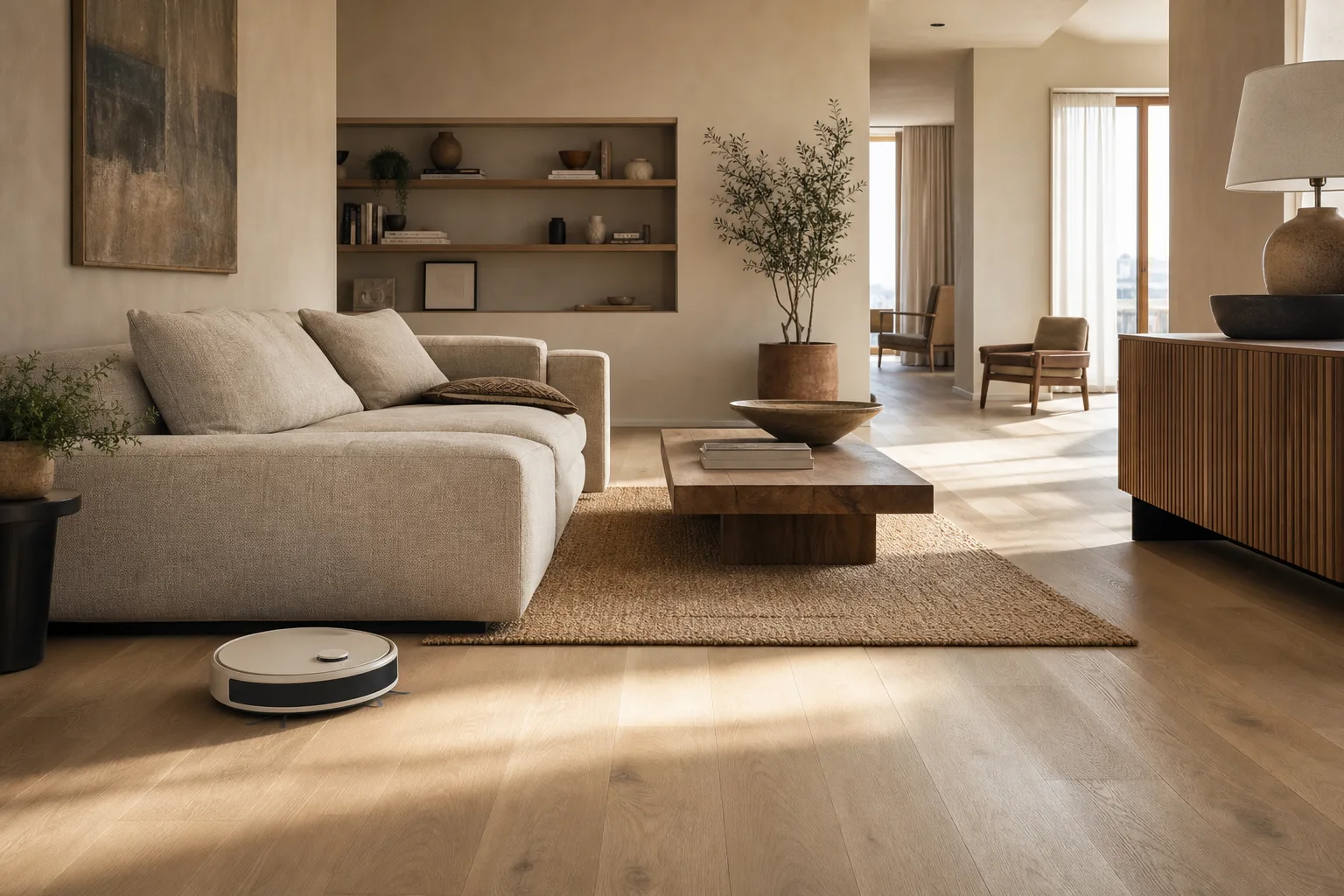
A compact floor plan can be ideal for automated cleaning, but only if the machine can move through the home without creating more work. Before comparing suction figures, look at the apartment as a route: where the robot starts, what it must cross and where it is likely to become trapped. The right model is not necessarily the one with the longest feature list. It is the one that can complete that route repeatedly with a maintenance routine the household will accept.
Measure the awkward parts first
Measure the lowest furniture clearance, the tallest threshold and the narrowest passage between chair legs. A robot that cannot reach beneath the sofa may leave the most inconvenient strip of floor untouched. One that repeatedly stalls at the transition into the kitchen is not truly cleaning the whole apartment.
Record the dock location as part of the same survey. Most docks need clear space in front and some room on each side for reliable entry. A self-emptying or mop-washing station may also need vertical clearance for its lid and convenient access for removing bags, tanks and dirty-water containers.
| Apartment pattern | Prioritize | Question before buying |
|---|---|---|
| Open studio | Reliable obstacle behavior and a compact charger | Will the dock become permanent visual clutter? |
| Several small rooms | Systematic mapping, room selection and no-go zones | Can it cross every doorway threshold? |
| Pets or long hair | Brush access, bin capacity and replaceable wear parts | How quickly can wrapped hair be removed? |
| Mixed rugs and hard floors | Rug behavior, mop lifting or room-specific cleaning | Will fringes and dark patterns cause interruptions? |
Choose navigation for your tolerance
Systematic mapping is valuable when rooms need different schedules or exclusion zones. In a simple studio, reliable obstacle behavior may matter more than an elaborate map. If shoes, charging cables or pet toys often stay on the floor, look for clear documentation about obstacle detection and expect that no system removes the need for basic tidying.
Map editing matters more than a polished three-dimensional view. Useful controls include splitting and merging rooms, adding no-go zones, setting a cleaning order and choosing different vacuum or mop behavior by room. Read the current app requirements and recent support documentation, because features can depend on region, account and model generation.
Privacy belongs in the comparison as well. A model with a camera-based obstacle system may offer better object recognition, while a lidar-only model may be more comfortable for another household. Check what the manufacturer says about image processing, cloud storage and account security instead of assuming that every sensor works the same way.
Automation is useful when the preparation becomes smaller than the task it replaces.
The dock is part of the furniture
Self-emptying and mop-washing docks reduce routine handling, but they occupy real floor and wall space. Check the full dimensions, lid clearance and the path required for the robot to enter. In a small apartment, a discreet standard charger can be a better fit than a tall service station.
A large dock transfers work rather than eliminating it. Dust bags must be purchased, clean-water tanks filled, dirty-water tanks emptied and trays washed. That trade can still be worthwhile, especially in a pet household, but it should be evaluated as a recurring routine rather than as “hands-free” cleaning.
Plan for hair, rugs and maintenance
Long hair and pet fur make brush design and easy removal more important. Thick rug edges, black patterns and loose fringes can challenge some sensors. Whatever the model, budget time for emptying bins, cutting wrapped hair and cleaning sensors. The most useful robot is the one whose maintenance routine you understand before purchase.
Replacement parts deserve the same attention as headline performance. Confirm that filters, side brushes, main brushes, mop pads and dock consumables are sold through a reliable channel. A low purchase price loses its advantage if a proprietary dust bag or roller disappears after one product cycle.
Do not overpay for suction alone
Manufacturers commonly promote a peak suction figure, but numbers from different brands are not necessarily measured under identical conditions. Pickup also depends on brush design, airflow, floor type, cleaning speed and the way the robot follows edges. Treat the published figure as one specification inside a system, not as a cross-brand ranking.
For an apartment, completion rate is often the more meaningful outcome: did the robot cover the intended rooms, return to the dock and avoid requiring a rescue? A model with modest marketing numbers can be the better choice if it performs that routine reliably.
Measure before you shortlist
- Lowest furniture clearance and narrowest chair-leg gap.
- Highest threshold and the edge profile of every rug.
- Available dock width, depth, lid clearance and nearby power.
- Location of cables, pet bowls, toys and floor-length curtains.
- Cost and availability of two years of filters, brushes, bags and pads.
- Whether camera-based navigation fits the household’s privacy preference.
Our selection frame
We compare apartment robot vacuums by route reliability, real dock footprint, obstacle behavior, brush access, replacement-part availability and the clarity of the manufacturer’s support documentation. We would shortlist mapping and obstacle features only after confirming that the machine physically fits the apartment.