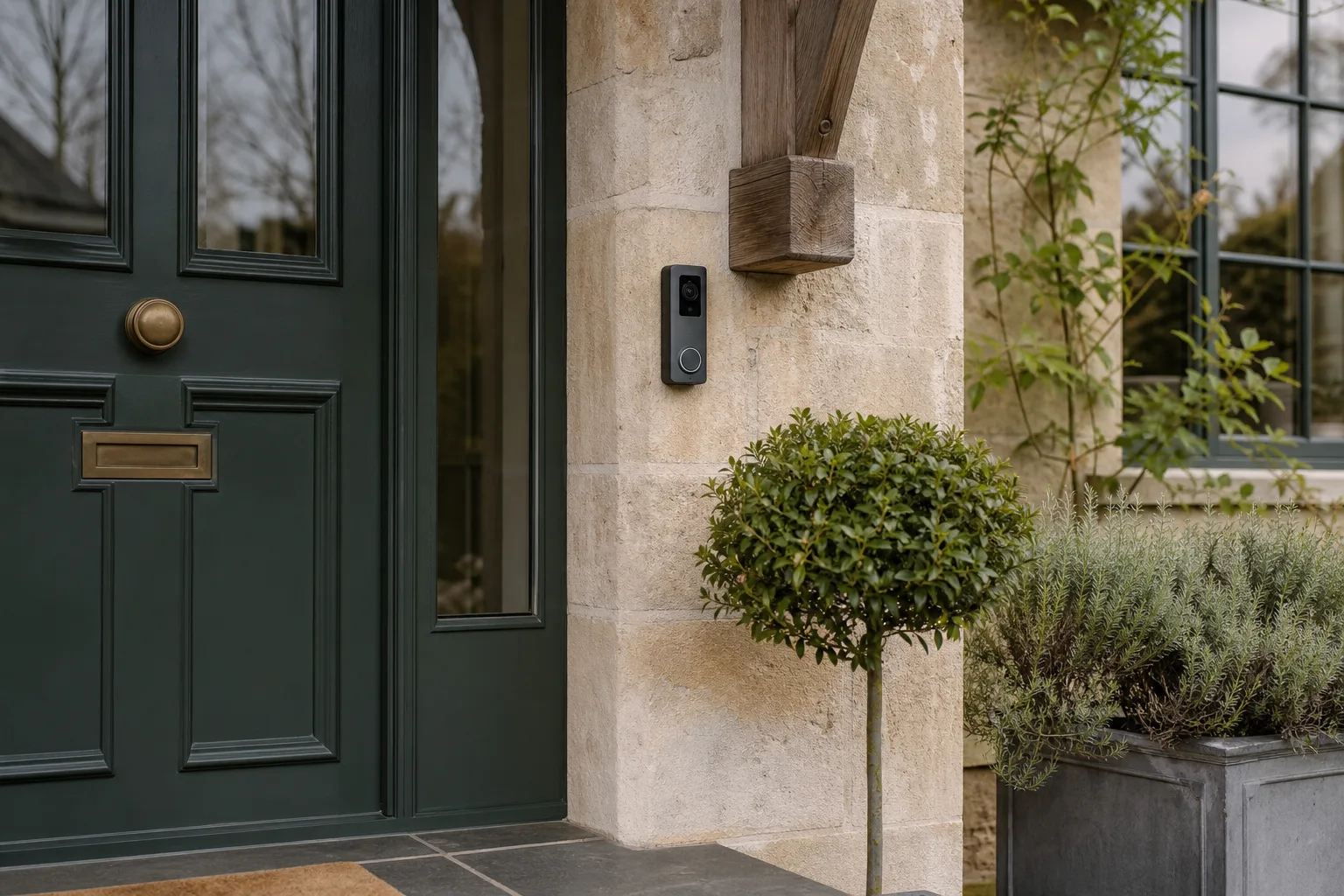
A battery doorbell is partly a camera and partly a long-term software decision. Ring’s Battery Doorbell Plus (2nd Gen) and Google’s Nest Doorbell (battery) can both show visitors, send motion alerts and work without new doorbell wiring. The practical difference is the system that surrounds each camera: how it frames the doorstep, stores missed events, fits the household app and returns to service after charging.
| Current published detail | Ring Battery Doorbell Plus (2nd Gen) | Google Nest Doorbell (battery) |
|---|---|---|
| Video | 2K, 1920 × 1920 | 960 × 1280, up to 30 fps |
| Framing | 1:1, 140° horizontal × 140° vertical | 3:4, 145° diagonal |
| Battery | Removable quick-release battery pack | Built-in rechargeable battery |
| Primary app | Ring app; strongest fit with Ring and Alexa | Google Home app; not compatible with the older Nest app |
| Included history | Live use without a plan; recorded history requires a Ring Protect plan | Three hours of event video history included |
Video framing matters more than a single number
Ring lists 2K video and a 140 by 140 degree head-to-toe field of view for the Battery Doorbell Plus second generation. Google lists 960 by 1280 video, a 3:4 aspect ratio and a 145 degree diagonal field of view for the Nest Doorbell battery model. Ring offers the higher published resolution; Nest's portrait framing is designed to keep people and parcels in view.
Neither specification guarantees the best picture at a particular doorway. Mounting height, backlighting and the distance to the path all change what the camera captures. Use each manufacturer's preview and mounting guidance before drilling.
Ring includes a corner kit, while Nest includes a 20-degree wedge. Those accessories can help when a doorbell sits on a wall perpendicular to the approach. Before choosing by resolution, take a phone photo from the proposed mounting point and check whether the view includes both a visitor’s face and the parcel area.
The ecosystem is the lasting choice
Ring is the natural fit for households already using Alexa or other Ring cameras. Nest belongs inside the Google Home app and works most naturally with compatible Google speakers and displays. Choosing the familiar app can matter more than a small difference in field of view because alerts, history and household access are daily interactions.
Also consider how many cameras may eventually share the account. Subscription structures can make one camera and a whole-home system very different financial decisions. Review current plans in the country where the doorbell will be used, because prices, feature names and availability can change.
The doorbell is replaced occasionally. Its app is used every time someone arrives.
Battery design changes the charging routine
Ring uses a removable quick-release battery pack, so a spare can reduce downtime. The Nest battery is built in, which means the doorbell itself must come indoors for charging. Both can connect to compatible existing wiring, but the wiring requirements and chime behavior differ. Check the official compatibility pages for the exact installation.
Google estimates about five hours for a full Nest Doorbell battery charge with a compatible 7.5-watt adapter. Its support guidance makes clear that battery life varies with activity, temperature and camera settings. A busy street can therefore create a much shorter charging interval than a quiet entrance.
Wiring does not turn either battery model into the same product as a purpose-built wired doorbell. It can provide charging assistance and chime support under compatible conditions, but the battery remains part of the power design. Cold weather is particularly important for Nest because its published charging range starts at 32°F/0°C.
Compare what happens after a missed alert
Live view and real-time answering are useful, but a doorbell camera often matters because nobody was looking at the phone. Google currently includes three hours of event video history with the Nest Doorbell battery model. Ring allows live use without a subscription, while recorded video history and several advanced alerts require a Ring Protect plan.
That does not automatically make one cheaper. The decision depends on how far back the household wants to review events, whether other cameras share the plan and which smart alerts are actually valuable. Treat the first year of service as part of the purchase price, not as an optional detail discovered after installation.
Installation and network reality
Check Wi-Fi at the exact mounting point with the door closed. Exterior walls, metal door frames and distance from the router can affect reliability. Ring recommends substantial upload capacity for its 2K model; Google also publishes bandwidth guidance for optimal video. If the signal is weak, the higher camera resolution on the box may not translate into a better everyday image.
Renters should confirm whether drilling is allowed and whether an approved no-drill mount is available. Homeowners replacing an existing wired chime should identify the transformer rating before assuming compatibility. If the system is unclear, a qualified installer is safer than experimenting with unknown low-voltage wiring.
Decision shortcut
- Choose Ring when removable charging, 2K square framing and an existing Ring or Alexa setup lead the decision.
- Choose Nest when the Google Home app, portrait framing and included short event history are more useful.
- Before either purchase, confirm Wi-Fi, mounting angle, chime compatibility and cold-weather charging conditions.
- Compare the current subscription cost for the history and alerts you actually intend to use.
Our considered verdict
Choose Ring when removable charging and a broader Ring or Alexa setup matter most. Choose Nest when Google Home is already the household dashboard and its portrait view suits the doorway. Before either purchase, decide whether the ongoing subscription features fit the budget; recording history and advanced alerts can change over time.
Bottom line
Ring has the stronger current camera specification and the more convenient removable battery. Nest offers a coherent Google Home experience and a small amount of included event history. The better purchase is the one whose app, charging routine and ongoing plan still make sense after the novelty of installation has passed.