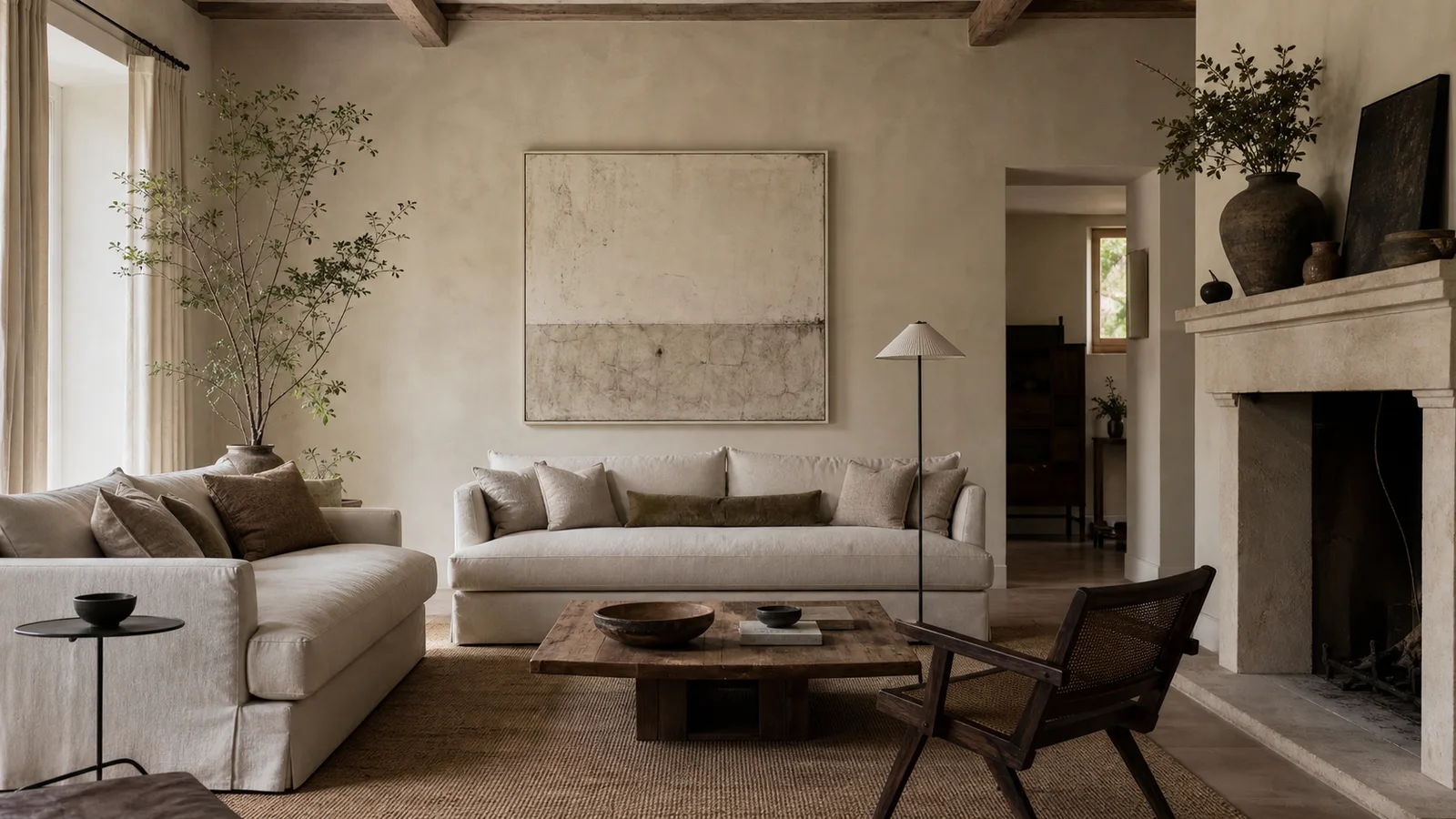
Rooms described as luxurious often share less than their price tags suggest. Some are richly coloured, others almost monochrome. Some contain antiques; others are sharply contemporary. What connects the strongest examples is control. Materials repeat, proportions feel deliberate and the eye is given somewhere to rest.
That kind of composure can be developed without rebuilding the room. In fact, working with existing architecture often encourages better editing because every addition has to justify itself.
Repeat before you replace
Choose two or three materials already present and let them recur. If a room has warm timber, bring the same tone into a frame, tray or lamp base. If brushed metal appears in the hardware, repeat it once more rather than introducing a competing finish.
Repetition creates coherence. It can make ordinary elements feel intentional and allows a room to carry variety without becoming noisy.
Correct the scale before adding detail
A room can contain beautiful objects and still feel unsettled when their scale does not relate. A rug that stops beneath the coffee table, curtains that end at the window frame or artwork stranded high above a sofa can make every element look smaller and more temporary.
Begin with the largest relationships. Let the rug connect the main seating, hang curtains with enough width to frame the window when open, and group art according to the furniture below it. These adjustments often create more calm than replacing decorative objects one by one.
Improve the touch points
Luxury is experienced at close range: the handle opened every morning, the switch pressed at night, the fabric against an arm. Upgrade the small, frequently touched elements before the distant decorative ones.
A convincing room is often remembered through touch before appearance.
A substantial curtain, a linen cushion cover or a well-proportioned cabinet pull can change the daily experience of a room. These details do not need to match in price; they need to share care.
Let softness do practical work
Textiles are not only visual. Curtains, rugs and upholstered surfaces change how a room sounds and how it holds temperature. In a sparse space, one generous curtain or correctly sized rug can reduce the hard echo that makes the room feel unfinished.
Layer by function rather than by quantity. A washable base, one warmer layer and a tactile accent are easier to maintain than a pile of cushions and throws chosen only to fill a photograph.
Control the contrast
Quiet does not mean beige. It means contrast used with purpose. A dark timber table can anchor pale upholstery. One deep green chair can give a warm neutral room its centre. The strongest contrast should help organise the space, not scatter attention across it.
Remove the weakest note
Editing is usually cheaper than shopping. Photograph the room from the doorway and notice what interrupts the composition: a cable crossing the floor, several small frames competing for attention, packaging left on an open shelf or a cool bulb inside an otherwise warm scheme.
Removing one weak note can allow the better materials to register. Empty space is not a missing purchase; it is the interval that gives shape to everything around it.
Leave something unresolved
Over-coordination can make a home feel staged. A handmade bowl, an inherited table or a painting that refuses the palette keeps the room human. The goal is not seamlessness. It is a sense that choices have accumulated thoughtfully over time.
Buy for the room that exists
Aspirational shopping becomes expensive when every object belongs to a future room. Buy for the dimensions, light and habits you have now. A modest chair that fits the available corner is more convincing than an impressive piece that blocks circulation.
Whenever possible, bring home material samples before large purchases. Timber changes beside the floor, fabric changes in evening light and stone can feel much busier at room scale than it did on a screen. Time spent observing is part of the design work.
Allow materials to age
Perfection is not the same as quality. Timber will mark, linen will soften and metals may acquire a patina. A home feels more settled when its materials can absorb ordinary use without every trace becoming damage.
This is another reason to spend on touch points and structural pieces before fragile decoration. Materials that improve through handling reduce the urge to protect the room from the people who live there.
That is the lasting appeal of quiet luxury: less performance, more discernment, and a room that becomes richer through use rather than fragile in the face of it.
Spend in this order
- Correct layout, scale and the placement of existing furniture.
- Remove visual noise and conceal the cables, packaging and clutter that remain.
- Improve lighting quality and give the room more than one controllable layer.
- Upgrade frequently touched details and textiles that solve a practical need.
- Repeat existing materials before introducing a new finish.
- Add art and personal objects slowly enough for them to retain meaning.