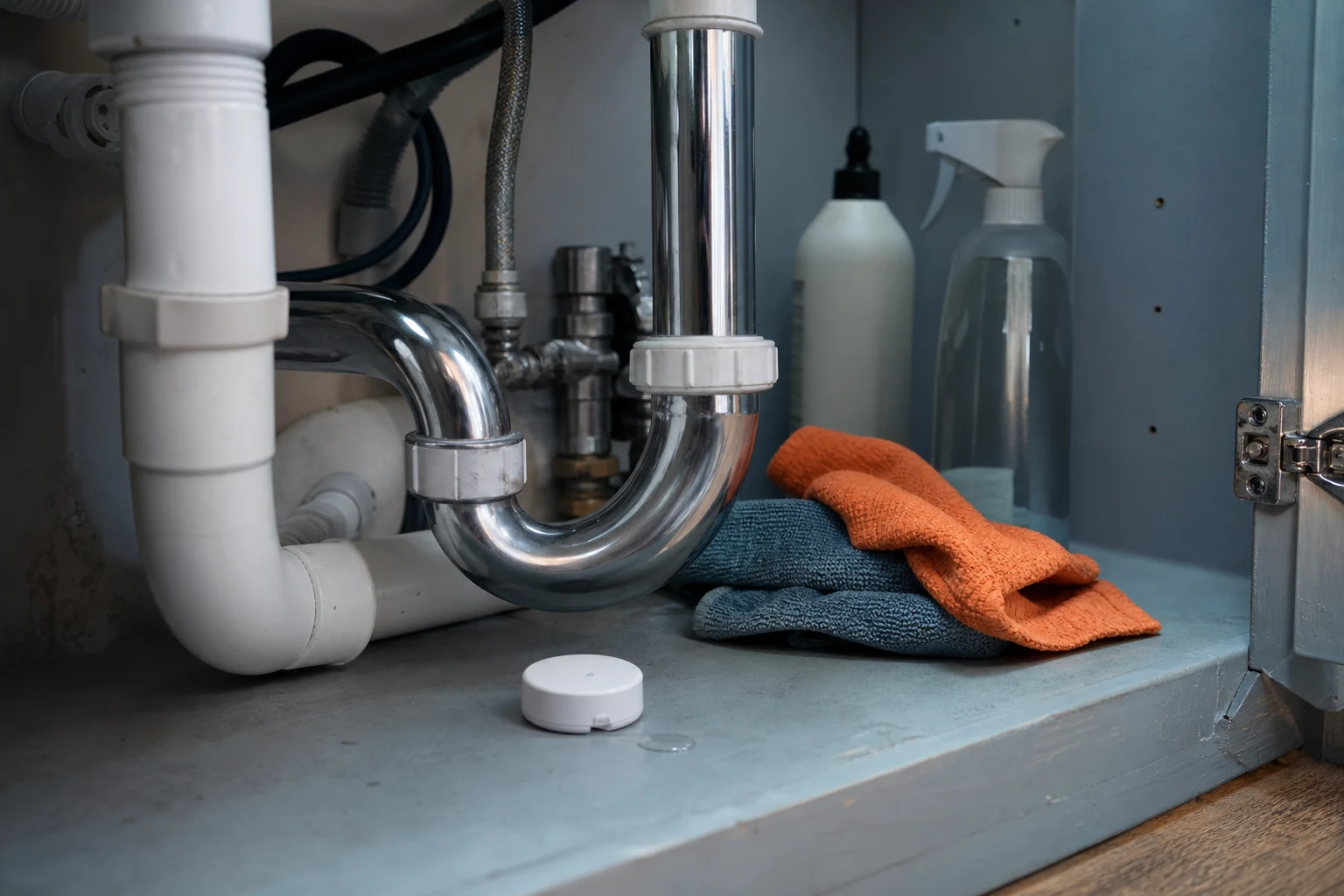
A water sensor is easy to buy and equally easy to put in the wrong place. Set high on a shelf, it may stay dry while water travels beneath the cabinet. Left with a dead battery or an old Wi-Fi password, it becomes a quiet puck of plastic. Useful protection comes from three linked decisions: where water is most likely to escape, how the device will detect it and what can happen after the alert.
Draw the wet map before choosing hardware
Walk through the home and mark every fixture, appliance and pipe connection that can release water. Begin with washing machines, dishwashers, water heaters, refrigerators with water lines, toilets, sinks, sump pumps and HVAC condensate drains. Add any pipework in an unheated or rarely visited space.
Then identify where water would travel. Cabinet lips, sloping floors and appliance feet can divert a small leak away from the most obvious spot. A point sensor must touch water to react, so place it at the lowest likely collection point rather than beside the appliance simply because the device looks tidy there.
Prioritize failures that could continue unattended. A slow drip under a sink and a washing-machine supply hose can both cause damage, but the second has access to a pressurized water line. The map should reflect consequence as well as probability.
Choose the kind of detection the problem needs
EPA WaterSense describes two broad approaches. Moisture sensors detect water at a particular place. Flow-monitoring devices watch water moving through a pipe and look for unusual patterns. Some systems combine the two.
| Protection layer | Best at | Limitation |
|---|---|---|
| Point moisture sensor | Low-cost coverage beneath a specific fixture or appliance | Water must physically reach the sensor |
| External flow monitor | Observing unusual whole-home or branch-line patterns without cutting the pipe | May not identify the exact location |
| In-line flow monitor | Whole-home measurement and, on some systems, automatic shutoff | More invasive installation; often needs a plumber |
| Appliance-specific shutoff | Stopping one known supply, such as a washing-machine line | Does not protect the rest of the plumbing |
A small apartment may benefit from several point sensors and a clear response plan. A detached home left empty for long periods may justify whole-house flow monitoring and automatic shutoff. The larger system is not automatically better; it is better only when installation, calibration and maintenance remain manageable.
An alert needs a person, a path and a valve
Ask what happens at 2 a.m. or while everyone is away. A local siren helps only when someone can hear it. An app notification helps only while the hub, router and internet connection are working. An automatic shutoff can limit continuing flow, but it must be installed correctly and should not become a substitute for locating and repairing the fault.
Write the response beside the device list: who receives the alert, where the main shutoff is, who can enter the home and which plumber or building manager to call. Label the main valve and make sure the people responsible can operate it. Technology shortens the time to action; it does not invent the action.
Place sensors where water will arrive first
- Under sinks: below supply stops and the trap, at the cabinet's lowest point.
- Washing machine: near the hose connections and beneath the front edge where water may escape.
- Water heater: in the drain pan when one is present, without blocking drainage.
- Refrigerator: near the water-line connection or along the likely path from behind the appliance.
- Toilet: behind or beside the base, where the sensor will not be kicked or soaked during cleaning.
- Sump and condensate equipment: at the overflow point the equipment manual identifies.
Use extension probes when the sensor body cannot sit in the vulnerable location. Keep devices away from routine splashes that create repeated nuisance alerts. An alert ignored because it happens every week is not useful protection.
Design for the day Wi-Fi changes
Connected sensors often disappear from attention after setup. Record which app, account and network each device uses. When the router or internet provider changes, reconnect the sensors before considering the network migration complete. If a hub is required, decide whether it needs backup power long enough to report during a short outage.
EPA guidance recommends checking connected devices after power outages or Wi-Fi changes. It also recommends cleaning sensors, keeping them correctly positioned, replacing batteries and testing function according to the manual. Add those tasks to an existing seasonal routine rather than trusting memory.
Renters can build a useful first layer
Whole-home shutoff equipment may be unavailable to a renter, but removable point sensors can still cover a washing machine, sink, toilet and water heater closet. Before attaching anything to shared plumbing, contact the owner or building manager. Ask where the unit and building shutoffs are and how emergency access works.
For owners planning a renovation, a plumber can create an accessible location for future flow monitoring even if the device is not installed immediately. Access and service space are worth designing before cabinetry closes around the main line.
A leak detector is not a single gadget. It is a chain from water, to sensor, to alert, to a person who can stop the flow.
A resilient leak plan
- Map every water-using appliance, fixture and hidden low point.
- Place point sensors where water will collect, not where the device looks neat.
- Decide which risks justify automatic shutoff or whole-home monitoring.
- Label the main valve and document who can respond when the home is empty.
- Test alerts, replace batteries and clean sensors on a recurring schedule.
- Reconnect every device after router, password, power or internet-provider changes.
Our selection frame
We would compare detection method, audible and remote alerts, battery reporting, local behavior during an internet outage, shutoff compatibility, installation requirements, data retention, subscription boundaries and the clarity of maintenance instructions.