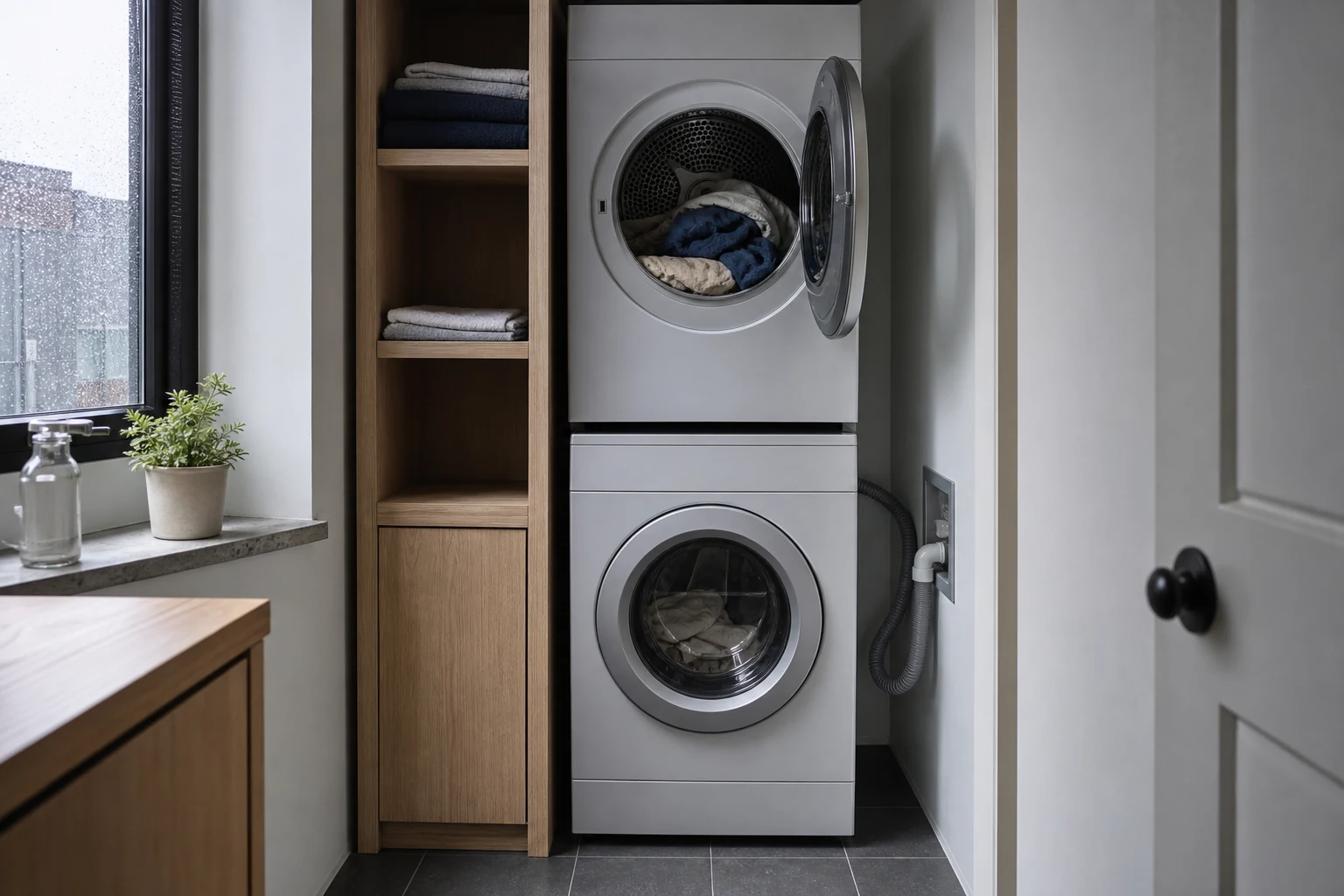
A heat-pump dryer is often introduced as an efficiency upgrade. In a small home, its more immediate effect may be architectural: it does not need to expel warm, humid air through a conventional dryer vent. That can make a laundry closet, accessory unit or interior utility space possible. But ventless does not mean placeless. The machine still needs air around it, a route for condensed water, service access and a household willing to maintain its filters.
Understand the closed loop
A conventional vented dryer heats air, moves it through the drum and sends the warm moist air outside. A heat-pump dryer removes moisture from the air, recovers heat and recirculates the air through the load. ENERGY STAR notes that this approach uses lower temperatures and can substantially reduce energy use compared with a standard dryer.
The lower-temperature process can be gentler on fabrics, but the experience depends on moisture sensing, load size, fabric mix and maintenance. The buying question is not merely whether a dryer uses a heat pump. It is whether the complete laundry routine fits the household.
Measure the working envelope, not only the cabinet
Product dimensions describe the box. Installation needs describe the space. Add clearance required by the manual, the depth of hoses and plugs, room for the door to swing and enough access to remove filters or service panels. In a closet, verify ventilation openings and door requirements even though the dryer itself is ventless.
For a stacked pair, use the manufacturer's approved stacking hardware and confirm that controls remain reachable. A shallow shelf beside the machine can hold a basket during unloading, but it should not obstruct airflow or prevent the appliance from moving forward for service.
| Space question | What to verify |
|---|---|
| Can the machine enter the home? | Doorways, stairs, turns, elevator and final alcove width |
| Can the door open fully? | Hinge side, opposing doors, hamper and circulation path |
| Can water leave? | Drain hose route or accessible condensate tank |
| Can filters be cleaned? | Front access, removal path and a nearby place to handle lint |
| Can it be serviced? | Ability to disconnect and pull the appliance forward |
Choose the drainage routine deliberately
The moisture removed from clothes becomes water that must go somewhere. Depending on the model, it can collect in a tank that the user empties or drain through a hose to a nearby standpipe, sink or shared washer drain arrangement approved by the manufacturer.
A tank creates location flexibility, but emptying it becomes part of every laundry cycle or several cycles. Direct drainage removes that task but requires a secure route with no kinks, accidental disconnection or improper rise. Decide which method the room supports before delivery.
Let the washer do more of the drying
The dryer begins with whatever moisture the washer leaves behind. ENERGY STAR recommends pairing a heat-pump dryer with a front-load washer that removes more water during its final spin. Even without replacing the washer, use the highest spin speed appropriate for the fabric and avoid sending a dripping load into the dryer.
Separate heavy towels from light shirts when possible. Mixed loads often run until the thickest item is dry, exposing lighter pieces to unnecessary tumbling. Sensor programs work best when the load has reasonably similar moisture and fabric weight.
Compare cycle rhythm, not a single advertised time
Some heat-pump cycles take longer than the household expects, especially with large or mixed loads. Product documentation and current ENERGY STAR material show that performance has improved, but model, program and load still matter. Look beyond a fastest-cycle claim and read the program table in the manual.
Ask how many loads the household completes in sequence. A two-person apartment doing a few evening loads has a different constraint from a family turning over uniforms, towels and bedding. A smaller drum may fit beautifully and still create a bottleneck if the washer capacity is much larger.
Filters are part of the appliance, not an afterthought
Heat-pump dryers may have more than one lint or heat-exchanger filter. Cleaning intervals and access differ. A clogged filter restricts airflow and undermines the efficiency the appliance was purchased to provide. Before buying, download the manual and look at every recurring cleaning task.
Favor a design whose filters can be removed, opened and cleaned without tools or awkward kneeling. If a condenser or heat exchanger requires periodic care, understand whether the user performs it or service is required. The elegant laundry alcove still needs a practical place for lint and a vacuum attachment.
Calculate the two price tags
The first price includes the appliance, stacking kit, electrical work, drainage parts, delivery and any cabinetry changes. The second includes energy, maintenance and the value of installation constraints avoided. In a home without an exterior vent route, the ability to install without adding a duct may matter as much as yearly electricity savings.
Use the EnergyGuide label and a local electricity rate for comparisons. National percentages describe a technology; the household bill depends on load frequency, program choice, washer extraction, utility price and the model's tested consumption.
Ventless is not permission to squeeze a dryer anywhere. It is an opportunity to design a better laundry route.
Before delivery day
- Measure the route into the home and the complete operating clearances.
- Confirm the electrical supply and manufacturer-approved stacking kit.
- Choose direct drainage or a realistic tank-emptying routine.
- Compare washer and dryer capacities, controls and door directions.
- Read the program table and every filter-maintenance instruction.
- Leave access to disconnect, move and service the appliance.
Our selection frame
We would compare tested energy use, drum volume, sensor behavior, program clarity, drainage options, filter access, refrigerant information, noise, stacking compatibility, warranty and the quality of service documentation. App features would come later.