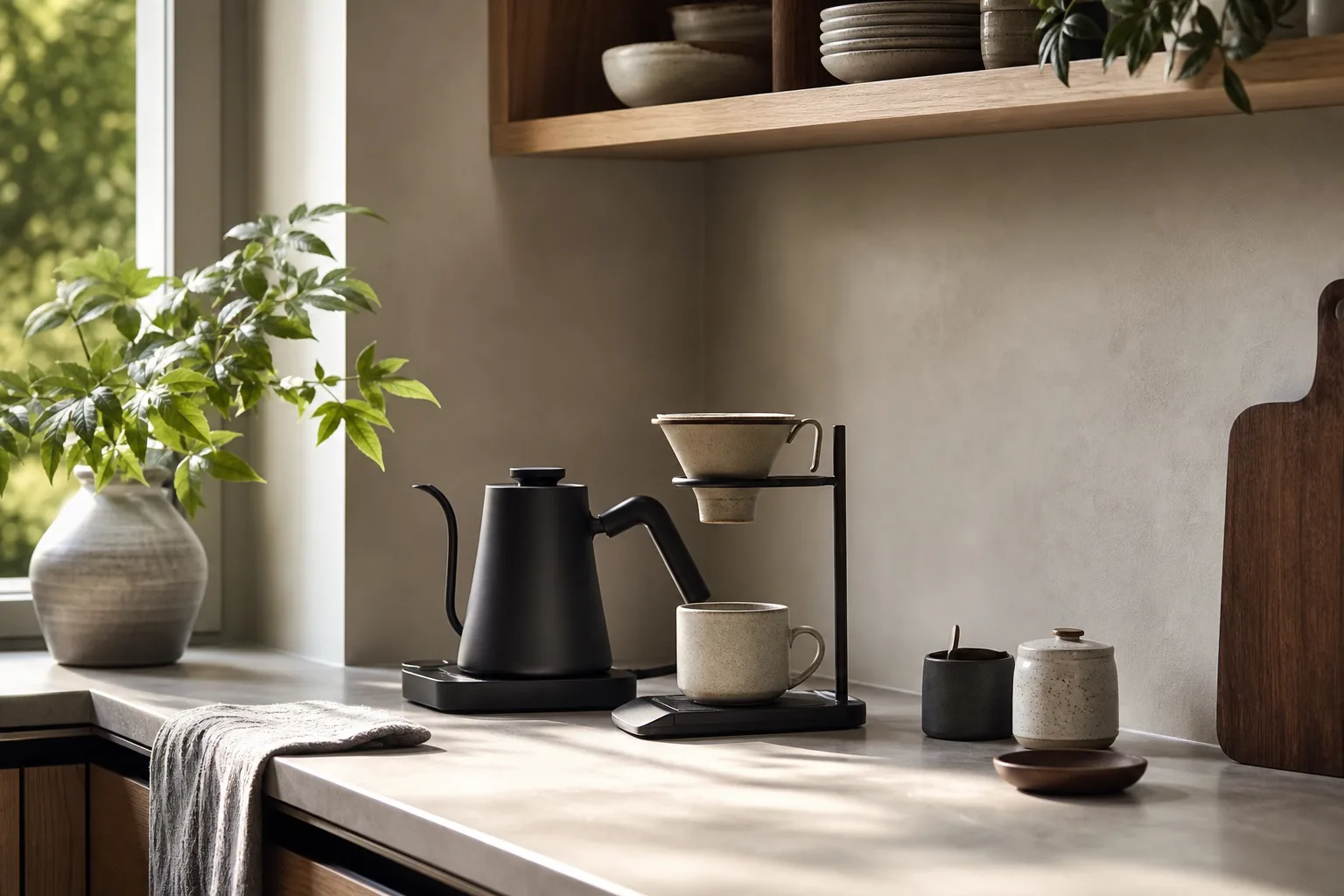
The Fellow Stagg EKG Pro is built around a specific ritual: heating water to an exact temperature and pouring it slowly enough to control a manual coffee brew. That focus explains both its appeal and its limits. It is a handsome everyday tool, but it is not the most direct answer for every household that needs hot water. Its premium is easiest to understand as a payment for control, interface and countertop presence rather than raw capacity or speed.
What the Pro model adds
Fellow lists a 104 to 212 degree Fahrenheit temperature range, exact temperature control, a full-color screen and a customizable menu. Wi-Fi is used for firmware updates rather than remote boiling. The gooseneck spout and counterbalanced handle are designed for a measured pour.
The Pro interface also adds scheduled heating, a guide mode with preset temperature suggestions, adjustable hold time, altitude settings and control over sound and units. Those details matter to someone who changes temperature by coffee or tea type and values repeatability. They matter less when the routine is simply to boil a full kettle as quickly as possible.
| Household need | How the Stagg EKG Pro fits | Likely better alternative |
|---|---|---|
| Daily pour-over coffee | Strong fit: controlled flow, precise temperature and repeatable settings | A simpler gooseneck if scheduling and menus are unnecessary |
| Tea across several styles | Useful when different temperatures are used regularly | A larger variable-temperature kettle for multiple cups |
| Fast family boiling | Specialized spout and 0.9-liter scale can feel restrictive | A wider-spout kettle with greater capacity |
| Occasional hot water | Most of the premium may remain unused | A reliable basic kettle |
The interface is part of the product
On a conventional kettle, the interface disappears after the switch is pressed. On the EKG Pro, it is a reason to buy. A color screen and menu make temperature, hold behavior and timing more explicit, but they also add settings that a minimalist user may never change.
Scheduling can be convenient for a fixed morning routine, while altitude adjustment is useful because water boils at a lower temperature as elevation rises. Firmware updates may refine the product over time, but Wi-Fi should not be mistaken for remote start: Fellow describes it as an update connection, not a way to turn on an unattended kettle from elsewhere.
Consider capacity and pace
A gooseneck is intentionally controlled. It is excellent for pour-over coffee and slower for filling a large French press, saucepan or group of mugs. Before paying for precision, consider whether the household's most common task benefits from a narrow stream.
The 0.9-liter capacity is appropriate for a focused coffee setup and less generous for several large cups. The counterbalanced handle and narrow spout aim to make the stream predictable, but that same behavior can feel unnecessarily slow when precision is not the task.
A premium tool is easiest to defend when its specialized behavior matches a repeated ritual.
The materials are not completely plastic-free
Fellow states that its EKG kettle interiors use 304 stainless steel, while some lid, base and handle components use food-safe polypropylene and silicone. Buyers specifically seeking an entirely plastic-free water path should read the manufacturer's material notes carefully.
This is a good example of why material claims need context. “Stainless-steel body” and “plastic-free” are not interchangeable descriptions. Anyone buying around a strict material preference should examine the current model’s lid, temperature sensor, seals and internal contact points rather than relying on the exterior finish.
Think beyond the first year
A countertop kettle is used frequently, so controls, handle comfort and replacement support matter more than they do on an occasional appliance. Check the warranty offered in the country of purchase, the availability of a compatible base and the manufacturer’s cleaning guidance. The finish may also affect care: polished surfaces, painted finishes and wood accents do not age in exactly the same way.
Scale buildup changes heating performance and taste over time. A premium kettle still requires ordinary descaling, and the narrow opening may influence how comfortable that task feels. The purchase makes more sense when the owner is willing to maintain it as a daily tool rather than treat it as a display object.
Before paying the premium
- Confirm that a 0.9-liter kettle covers the household’s normal volume.
- Decide whether a controlled gooseneck pour is useful most days.
- Identify which Pro features—schedule, guide mode, hold or altitude—you will actually use.
- Read the current materials guide if a plastic-free water path is important.
- Compare warranty, replacement support and cleaning access in your market.
Our considered verdict
The Stagg EKG Pro is compelling for a design-conscious pour-over setup where precise temperature and flow control are used every day. Its schedule, guide mode and configurable interface reward a stable ritual. A simpler variable-temperature kettle is the more rational choice for broad kitchen use, larger pours or households that do not need the Pro menu.
Bottom line
Choose it because controlled pouring and repeatable temperature are central to the routine—not because it is the most expensive or most decorative way to boil water. The Pro features are valuable only when they shorten a real sequence you repeat.