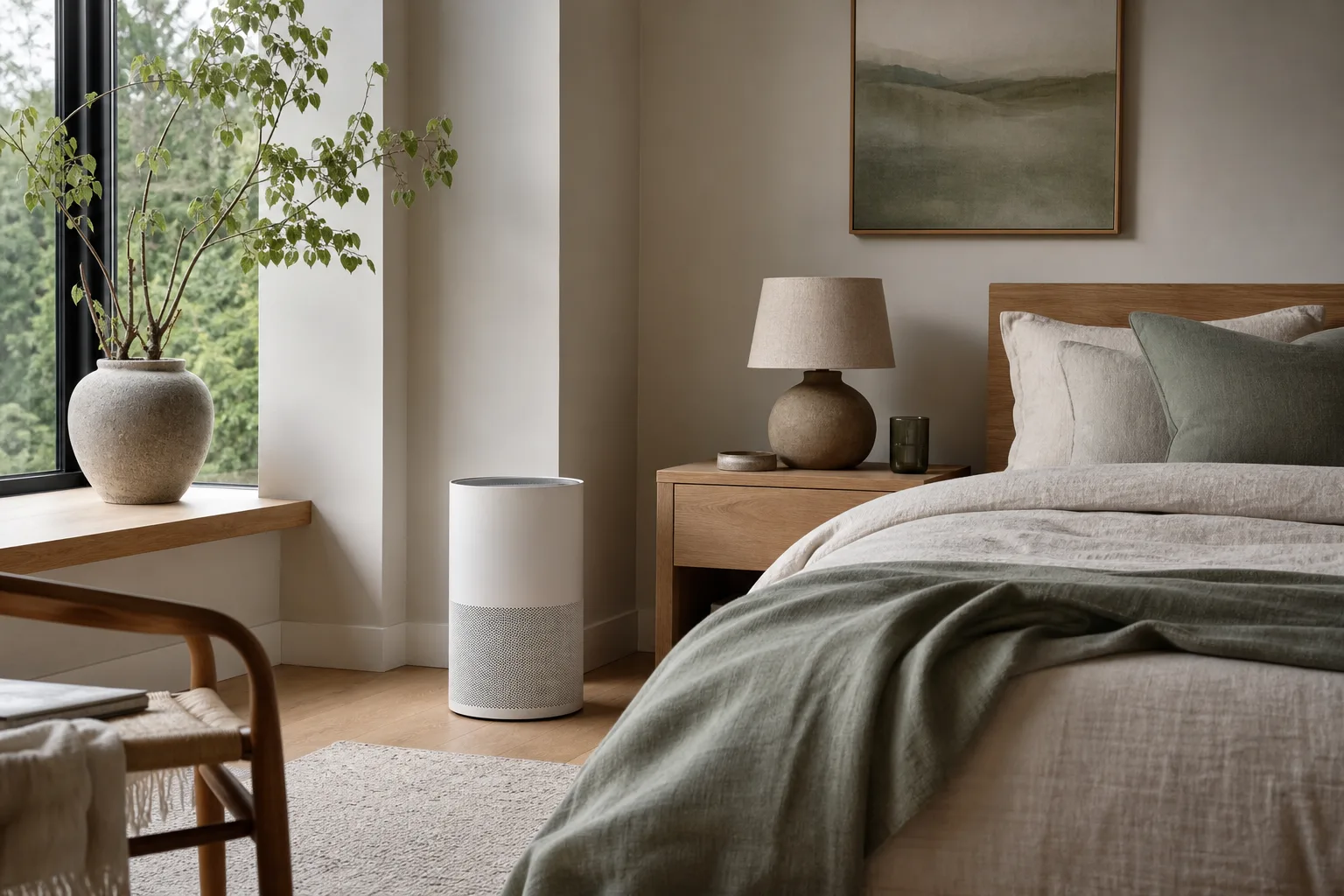
Air purifiers are often sold through dramatic claims, but the machine has a modest job: move room air through the right filter often enough to make a meaningful difference. For a small bedroom, that makes sizing, sound and upkeep more important than a long list of app features. A purifier cannot remove every pollutant, and it should supplement source control and clean-air ventilation rather than replace them.
Start with the room, including its height
Measure the floor area and note whether the ceiling is higher than the standard eight feet. The U.S. Environmental Protection Agency recommends choosing a clean air delivery rate, or CADR, large enough for the space. Its reference table suggests a minimum smoke CADR of 130 cfm for a 200-square-foot room and 195 cfm for 300 square feet.
Those figures are an estimate rather than a universal promise. Open doors, tall ceilings and an adjoining dressing area increase the volume of air the machine must serve. Slightly oversizing the purifier can also let it run at a quieter middle speed instead of its loudest setting.
| Room area | EPA reference minimum smoke CADR | What to check |
|---|---|---|
| 100 sq ft | 65 cfm | Useful for a compact bedroom with an eight-foot ceiling. |
| 200 sq ft | 130 cfm | Common bedroom scale; size up for tall ceilings or open doors. |
| 300 sq ft | 195 cfm | Treat connected areas as part of the served space. |
CADR is normally reported at the purifier’s highest fan speed. That is important because the quietest mode may move much less air. A credible product page should make it possible to connect the room-size claim to a published CADR rather than relying only on language such as “large-room coverage.”
Judge noise at the speed you will actually use
A low sleep-mode number is useful, but it does not tell you how the purifier sounds while doing substantial work. Look for published noise figures across several fan speeds. A steady low hum is usually easier to live with than an irregular motor tone or electronic chime.
Think about the overnight routine as well. Can the display be switched fully off? Does the purifier remember that setting after a power interruption? Can button sounds be disabled? If the machine depends on an app for basic control, check whether the same functions remain available on the unit itself.
The best bedroom purifier is not the most powerful machine. It is the one you will leave running.
Separate particles from gases
Particle filters and gas filters do different jobs. A particle filter can address dust, pollen and smoke particles. Activated carbon or another adsorbent material is needed for gases and some odors, and the amount of that material matters. A thin carbon sheet should not be treated as equal to a substantial carbon bed.
CADR describes particle-cleaning performance; it does not rate gas removal. If odor or volatile organic compounds are the main concern, look for a manufacturer that explains the type and quantity of adsorbent media. Avoid assuming that every “three-stage” filter has the same capacity simply because the layers carry similar names.
Also check whether the purifier intentionally produces ozone or uses an ionizing feature. The EPA advises consumers to avoid devices that intentionally produce ozone in occupied spaces. If an optional ionizer is included, decide whether it can be switched off independently.
Price the replacement filter, not only the machine
Check the official replacement interval, current filter availability and annual cost. A bargain purifier with a proprietary filter that is frequently unavailable is not a bargain. Also consider whether the pre-filter can be cleaned easily and whether the display can be fully dimmed at night.
Replacement timing is affected by runtime and pollutant load, so an indicator based only on elapsed hours is not a measurement of filter condition. For comparison, calculate the cost of the machine plus two years of replacement filters. That number is more useful than the initial discount.
Place it where air can actually move
A purifier needs clearance around its air intake and outlet. Squeezing it behind curtains, beneath a desk or tightly against a wall can restrict flow. In a bedroom, a location a short distance from the bed may provide a better balance of sound and circulation than placing it directly beside the pillow.
Keep doors and windows consistent with the task. During a smoke event, opening a window can introduce more particles; at other times, ventilation with clean outdoor air may be the more useful first step. The purifier is one part of an indoor-air plan, not a sealed solution.
Bedroom shortlist
- Measure the full served area and adjust for ceilings above eight feet.
- Compare smoke CADR, not only a marketing room-size number.
- Check sound and airflow at the speed you expect to run overnight.
- Confirm that displays and button sounds can be disabled.
- Price two years of genuine replacement filters before buying.
- Choose particle and gas filtration according to the pollutant you actually need to address.
Our conclusion
For a small bedroom, start with a verified smoke CADR and realistic overnight speed. Then compare sound, display control, filter availability and two-year running cost. App control is useful only after those fundamentals are right.